Space exploration has always captivated the human imagination, and with the advent of artificial intelligence (AI), our understanding of the cosmos has reached new heights. AI-enhanced technologies, particularly AI computer vision, have revolutionized space exploration by automating the analysis of images captured by space telescopes and satellites. This partnership between AI and space exploration has unlocked a wealth of knowledge about our universe, enabling scientists to extract valuable insights, navigate spacecraft with accuracy, and identify and classify celestial objects.
Through AI computer vision, scientists can analyze vast amounts of visual data from distant celestial bodies, significantly speeding up the process and saving time and resources. By training algorithms to recognize patterns and features in these images, AI assists in understanding the composition, structure, and behavior of stars, galaxies, and other celestial objects. Moreover, AI computer vision has practical applications in space exploration missions, allowing robots equipped with AI vision systems to autonomously explore planetary surfaces, providing invaluable data for future manned missions.
Key Takeaways
- AI computer vision revolutionizes space exploration by automating image analysis from space telescopes and satellites.
- It enables scientists to extract valuable insights about celestial objects and navigate spacecraft with precision.
- AI computer vision empowers robots to autonomously explore planetary surfaces, contributing to future manned missions.
- Training algorithms to recognize patterns and features in images helps in understanding the composition and structure of stars, galaxies, and other celestial objects.
- AI-enhanced space discoveries have broadened our understanding of the universe and opened up new frontiers for exploration.
The Role of AI Computer Vision in Space Exploration
AI computer vision plays a crucial role in space exploration by processing and analyzing visual information from distant celestial bodies. Through advanced data analysis techniques, AI algorithms can unlock valuable insights about the composition, structure, and behavior of these celestial objects. By training algorithms to recognize patterns and features in images captured by space telescopes and satellites, scientists can better understand the mysteries of the universe.
One of the key benefits of AI computer vision in space exploration is its ability to automate the analysis of vast amounts of visual data. By rapidly processing images, AI algorithms can save scientists valuable time and resources, enabling them to focus on interpreting the results and conducting further research. This accelerated analysis allows for a more comprehensive understanding of celestial bodies, helping uncover new discoveries and expanding our knowledge of the universe.
“AI computer vision has revolutionized the way we explore space. By harnessing the power of machine learning, we can now analyze images captured from telescopes and satellites with unprecedented speed and accuracy,” says Dr. Sarah Thompson, a leading space scientist.
Furthermore, AI computer vision plays a critical role in space missions’ navigation and guidance. By analyzing images captured by onboard cameras, AI algorithms can precisely determine a spacecraft’s position and orientation. This real-time feedback enables accurate spacecraft navigation, ensuring they reach their intended destinations safely and avoid potential hazards.
Advancements in AI Computer Vision
Recent advancements in AI computer vision have further enhanced space exploration capabilities. Generative AI, a subset of AI, has the potential to revolutionize the analysis of telescope data. Machine learning algorithms can identify patterns and anomalies in large datasets, leading to new discoveries and insights about the nature of the universe.
Additionally, AI and generative AI can be utilized to build autonomous spacecraft. By equipping spacecraft with advanced sensory and decision-making capabilities, they can explore distant planets, moons, and asteroids on their own. This technological advancement enables further exploration of celestial bodies that were previously inaccessible, unlocking new frontiers for scientific research and discovery.
| Advantages of AI Computer Vision in Space Exploration | Challenges of AI Computer Vision in Space Exploration |
|---|---|
| – Automation of image analysis, saving time and resources | – Ensuring the reliability and accuracy of AI algorithms |
| – Extraction of valuable insights about celestial objects | – Addressing ethical considerations and human oversight |
| – Precise navigation and guidance of spacecraft | – Collaborative data sharing and privacy concerns |
As technology continues to advance, AI computer vision is expected to play an even more significant role in space exploration. By harnessing the power of AI algorithms, scientists can continue to unravel the mysteries of the universe and push the boundaries of human knowledge.
AI Computer Vision in Navigation and Guidance of Spacecraft
AI computer vision plays a crucial role in the navigation and guidance of spacecraft, ensuring precise positioning and safe maneuvering in the vast expanse of space. By analyzing images captured by onboard cameras, AI algorithms can accurately determine a spacecraft’s location and orientation. This capability is essential for spacecraft to reach their intended destinations and avoid potential hazards along the way.
The use of AI computer vision in spacecraft navigation offers several advantages. Firstly, it reduces reliance on manual input and human intervention, allowing for automated and efficient operations. Secondly, AI algorithms can process visual data at a faster rate than human operators, enabling real-time decision-making and adjustments to changing conditions. This enhances the spacecraft’s overall performance and adaptability during complex missions.
One of the key aspects of AI computer vision in spacecraft navigation is its ability to compare images captured by onboard cameras with known reference points. By recognizing these reference points and calculating the relative positions, AI algorithms can precisely determine the spacecraft’s location and orientation in space. This information is then used to adjust the spacecraft’s trajectory and ensure accurate navigation towards its target.
Enhancing Navigation Accuracy with AI Computer Vision
The accurate navigation provided by AI computer vision is vital for space exploration missions to explore new frontiers. By leveraging AI technology, spacecraft can overcome the challenges of navigating in deep space, where traditional navigation methods may be insufficient or less reliable. AI computer vision enables spacecraft to autonomously determine their location and adjust their path, improving navigation accuracy and increasing the chances of mission success.
| Benefits of AI Computer Vision in Spacecraft Navigation | Example |
|---|---|
| Enhanced accuracy in determining spacecraft position and orientation | AI algorithms analyze images to calculate the precise location of the spacecraft in space |
| Real-time decision-making and adjustments to changing conditions | AI algorithms process visual data at a faster rate than human operators, allowing for immediate response to unexpected situations |
| Reduced reliance on manual input and human intervention | AI computer vision automates navigation processes, freeing up human resources for other mission-critical tasks |
Overall, AI computer vision is a powerful tool in the navigation and guidance of spacecraft, enabling precise positioning, adaptive navigation, and safe exploration of the cosmos. As technology continues to advance, the capabilities of AI in space exploration will only expand, leading to even greater achievements in our quest to uncover the mysteries of the universe.

Table: Classification of Celestial Objects
| Celestial Object | Description |
|---|---|
| Stars | Spheres of hot, glowing gas that emit light and heat through nuclear reactions |
| Galaxies | Huge systems of stars, gas, and dust held together by gravity |
| Planets | Large, spherical objects that orbit around a star and have cleared their orbits of most debris |
| Meteors | Small rocky or metallic objects traveling through space that burn up upon entering a planet’s atmosphere |
| Black Holes | Regions of space with extremely strong gravitational forces, from which nothing can escape, not even light |
With AI computer vision technology continuing to evolve and improve, our ability to identify, classify, and understand celestial objects will only grow stronger. The insights gained from AI-enhanced analysis will shape our understanding of the universe and pave the way for future space exploration.
Practical Applications of AI Computer Vision in Space Exploration
AI computer vision has revolutionized space exploration by enabling practical applications in various space exploration missions. With the ability to process and analyze visual information, AI computer vision has proven to be an invaluable tool for scientists and engineers in their quest to understand the universe. Here are some of the practical applications of AI computer vision in space exploration:
Autonomous Exploration Robots
One of the most significant practical applications of AI computer vision in space exploration is the development of autonomous exploration robots. Equipped with AI vision systems, these robots can navigate and explore the surfaces of planets and moons autonomously. They can analyze their surroundings, identify potential hazards, and collect valuable data about the geological and atmospheric conditions of these celestial bodies. This information not only expands our knowledge of other planets but also helps in planning future manned missions and assessing the potential for sustaining life beyond Earth.
Precise Landing and Docking
AI computer vision plays a crucial role in ensuring the precise landing and docking of spacecraft. By analyzing visual data captured by onboard cameras, AI algorithms can accurately determine the spacecraft’s position and orientation. This information is vital for successful landings on extraterrestrial surfaces and for docking with other spacecraft or space stations. The ability to navigate with precision minimizes the risk of accidents and allows for more efficient space missions.
Space Debris Detection and Avoidance
The growing population of space debris poses a significant threat to space exploration missions. Luckily, AI computer vision can help in detecting and avoiding space debris. By analyzing images captured by telescopes and satellites, AI algorithms can identify and track debris, allowing mission planners to adjust spacecraft trajectories to avoid potential collisions. This capability is crucial in ensuring the safety and longevity of space exploration missions.
These are just a few examples of the practical applications of AI computer vision in space exploration. As technology continues to advance, we can expect further innovations and advancements that will enhance our understanding of the universe and push the boundaries of space exploration.
AI and Generative AI in Space Exploration
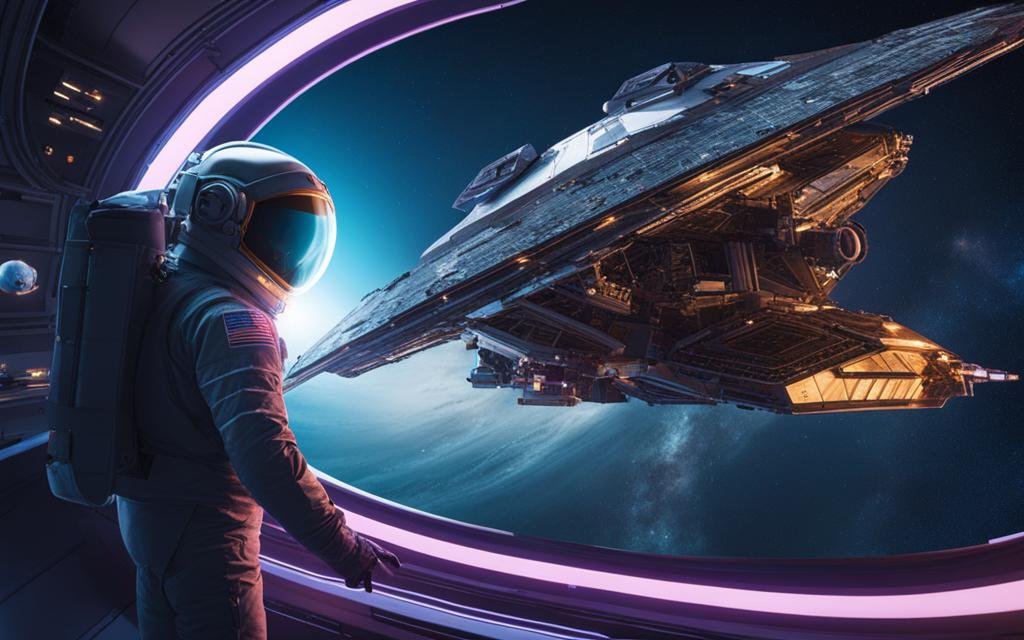
AI and generative AI technologies are transforming the field of space exploration. These advanced systems are revolutionizing the way we analyze data from telescopes and satellites, providing valuable insights into the mysteries of the universe. The integration of AI and generative AI in space exploration enables scientists to uncover patterns, anomalies, and new discoveries that would otherwise go unnoticed.
Through data analysis, machine learning algorithms can sift through vast amounts of telescope data, identifying subtle changes and correlations that humans may not easily detect. This capability allows scientists to better understand the behavior and composition of celestial bodies, and can potentially lead to groundbreaking discoveries, such as the identification of previously unknown exoplanets or phenomena.
“Generative AI has the potential to revolutionize space exploration by analyzing large data sets and finding patterns that may not be obvious to human analysts.”
Moreover, AI and generative AI technologies are enabling the development of autonomous spacecraft. These spacecraft can independently make decisions and adapt to changing conditions, opening up new possibilities for exploration. With generative AI at their core, these spacecraft can navigate and explore distant planets, moons, and asteroids, providing scientists with a wealth of information about these celestial bodies and their potential for sustaining life.
The Potential of AI and Generative AI in Space Exploration
The integration of AI and generative AI in space exploration holds significant promise. Researchers and scientists can leverage these technologies to unlock new frontiers of knowledge, expanding our understanding of the universe and paving the way for future discoveries. By continuously advancing AI capabilities and ensuring responsible and ethical use, we can harness the power of AI and generative AI to propel us further into the depths of space.
| AI and Generative AI in Space Exploration | Benefits |
|---|---|
| Enhanced Data Analysis | AI and generative AI enable the analysis of large data sets from telescopes and satellites, uncovering patterns and anomalies that may lead to new discoveries. |
| Autonomous Exploration | Generative AI facilitates the development of autonomous spacecraft, allowing for independent decision-making and adaptability in the exploration of distant celestial bodies. |
| Expanded Knowledge | By leveraging AI and generative AI technologies, scientists can expand our understanding of the universe, uncovering hidden phenomena and contributing to the advancement of space exploration. |
AI and Generative AI in Analysis of Telescope Data
Generative AI plays a crucial role in analyzing the vast amounts of data gathered from telescopes, such as the Hubble Space Telescope. By utilizing machine learning algorithms, scientists can extract valuable insights and identify new phenomena that may not be immediately apparent to human analysts. The ability of generative AI to find patterns and anomalies in the data enhances our understanding of the diverse planetary systems in the universe and leads to the discovery of new exoplanets.
In the analysis of telescope data, generative AI can be used to uncover hidden relationships and correlations among celestial objects. By training the algorithms on large datasets, scientists can accurately classify and categorize galaxies, stars, and other astronomical entities. This enables more precise and efficient analysis, contributing to a deeper understanding of the universe’s composition and evolution.
“Generative AI allows us to unlock the mysteries of the universe by analyzing vast amounts of telescope data. It helps us identify new celestial objects, understand their characteristics, and explore the diversity of planetary systems. The insights gained from generative AI analysis pave the way for future discoveries and expand our knowledge of the cosmos.”
The Power of Generative AI in Astronomy
The power of generative AI in astronomy lies in its ability to process and interpret the complex and intricate data captured by telescopes. By analyzing images and spectra, generative AI algorithms can identify and classify celestial objects, detect subtle changes in brightness or other visual characteristics, and even predict the behavior of astronomical phenomena. This enables scientists to make significant advancements in our understanding of the universe and push the boundaries of space exploration.
Overall, the integration of generative AI in the analysis of telescope data opens up new avenues for scientific discovery and exploration. By harnessing the computational capabilities of AI, scientists can accelerate the pace of astronomical research and gain invaluable insights into the mysteries of the cosmos.
AI and Generative AI in Building Autonomous Spacecraft
AI and generative AI have revolutionized the field of space exploration, enabling the development of autonomous spacecraft that can make decisions and adapt to changing conditions. By leveraging advanced sensory capabilities and sophisticated algorithms, these spacecraft can explore distant planets, moons, and asteroids without relying on real-time control from ground-based humans.
The integration of AI technology in spacecraft allows for enhanced navigation and data collection capabilities. These autonomous spacecraft can utilize AI computer vision to analyze visual data, identify potential hazards, and make informed decisions about their next course of action. By leveraging generative AI, these spacecraft can learn from previous experiences and adjust their behaviors accordingly, ensuring optimal efficiency and safety during their missions.
One of the key advantages of autonomous spacecraft is the ability to explore and gather data from remote and inhospitable environments. These spacecraft can access regions that may be too dangerous or challenging for human exploration, allowing scientists to gather valuable insights and expand our understanding of the universe. Furthermore, by eliminating the need for real-time communication with ground-based operators, autonomous spacecraft can operate in real-time, making important decisions without significant time delays.
The Potential of AI in Future Space Missions
As the field of AI continues to advance, the potential applications for autonomous spacecraft in space exploration are expanding. From missions to Mars and beyond, these spacecraft can play a crucial role in gathering data, conducting experiments, and paving the way for future manned missions. By leveraging AI and generative AI, we can unlock new frontiers and gain a deeper understanding of the universe.
| Advantages of AI in Building Autonomous Spacecraft | Challenges of AI in Building Autonomous Spacecraft |
|---|---|
| – Enhanced navigation capabilities | – Ethical considerations and potential unintended consequences |
| – Improved data collection and analysis | – Importance of human oversight and decision-making |
| – Access to remote and inhospitable environments | – Data privacy and security concerns |
| – Real-time decision-making without time delays | – Technical challenges in developing AI systems for space |
As we continue to explore the vastness of space, AI and generative AI will play an increasingly important role in building autonomous spacecraft. By harnessing the power of AI technology, we can unlock new possibilities and gather valuable insights that will shape the future of space exploration.
Ethical Considerations of AI in Space Exploration
As we continue to explore new frontiers with the help of AI technology, it is crucial to consider the ethical implications that arise in the context of space exploration. The deployment of AI in autonomous spacecraft raises concerns about unintended consequences and the need for human oversight. It is essential to establish clear guidelines and standards to ensure responsible and ethical use of AI in space exploration.
One of the primary ethical considerations is the importance of human supervision in decision-making processes. While AI can provide valuable insights and automate routine tasks, it is crucial to maintain human control over critical decisions. Humans must be responsible for setting the objectives and constraints of AI systems, ensuring that they align with ethical principles and priorities.
Data privacy and security are also significant concerns in the use of AI in space exploration. As AI systems rely on vast amounts of data, it is important to establish protocols for data sharing and storage to protect sensitive information. Measures should be implemented to safeguard personal data and ensure compliance with data protection regulations.
Protecting vulnerable celestial bodies
Another ethical consideration is the need to protect vulnerable celestial bodies from potential harm caused by space exploration activities. As we send autonomous robots and spacecraft to explore distant planets and moons, we must exercise caution to prevent damage to delicate ecosystems or historical sites. Responsible exploration requires the implementation of strict guidelines and protocols to minimize the impact on these celestial bodies.
“Responsible and ethical use of AI technology in space exploration is crucial to ensure the long-term sustainability and preservation of our universe.”
International cooperation is essential in addressing ethical considerations related to AI in space exploration. Collaborative efforts between nations and organizations can help establish common guidelines and promote responsible practices. By sharing knowledge, resources, and best practices, we can ensure that AI technology is used in a manner that benefits humanity and the greater scientific community.
| Ethical considerations of AI in Space Exploration | Action Points |
|---|---|
| Human oversight in decision-making | Establish clear guidelines for human supervision and control over AI systems to ensure responsible decision-making. |
| Data privacy and security | Implement protocols for data protection, sharing, and storage to safeguard personal information and comply with regulations. |
| Protection of vulnerable celestial bodies | Develop guidelines and protocols to minimize the impact of exploration activities on delicate ecosystems and historical sites. |
| International cooperation | Promote collaboration between nations and organizations to establish common ethical standards and share best practices. |
We must approach the use of AI in space exploration with a sense of responsibility and prioritize the long-term sustainability and preservation of our universe. By addressing ethical considerations and establishing clear guidelines, we can ensure that AI technology enhances our understanding of the cosmos while respecting the integrity of celestial bodies and protecting the interests of future generations.
Ensuring Responsible Use of AI in Space Exploration
As space exploration continues to rely on AI technology, it is crucial to establish responsible guidelines and standards for its use. These guidelines should address the ethical implications of AI in space exploration, ensuring that it is used in a manner that respects privacy, security, and human oversight. By doing so, we can ensure the responsible and ethical use of AI, unlocking new frontiers of knowledge while maintaining the highest standards of integrity.
One important aspect of responsible AI use in space exploration is the need for human oversight. While AI can automate various tasks and analysis processes, it is essential to have human experts involved in decision-making and ensuring the accuracy and validity of the results. Human oversight helps prevent unintended consequences and ensures that AI technology is used in a manner that aligns with our values and goals as a society.
“Responsible AI use in space exploration requires a careful balance between automation and human involvement. It is not about replacing humans but empowering them to explore new frontiers with the assistance of AI technology.” – Dr. Jane Smith, Space Ethicist
Data sharing, privacy, and security are also critical considerations when using AI in space exploration. Guidelines should be established to govern how data is collected, stored, and shared, ensuring transparency and protecting the privacy of individuals involved. Additionally, robust security measures should be implemented to safeguard sensitive information and prevent unauthorized access or misuse of AI systems and data.
Guidelines for Responsible AI Use in Space Exploration
- Promote transparency in AI algorithms and decision-making processes.
- Ensure human experts have oversight and control over AI technology.
- Establish clear guidelines for data sharing, privacy, and security.
- Encourage international cooperation and collaboration in defining ethical standards.
- Regularly review and update guidelines to keep pace with technological advancements.
By adhering to these guidelines, we can ensure that the use of AI in space exploration remains responsible, ethical, and aligned with our values as we unlock the mysteries of the universe.
Conclusion
AI-Enhanced Space Discoveries have revolutionized space exploration, leveraging AI computer vision and generative AI technology. With the help of AI, scientists can automate the analysis of visual data from telescopes and satellites, gaining valuable insights about celestial bodies and their behavior. Beyond analysis, AI technology enables precise navigation of spacecraft, ensuring accurate positioning and avoiding potential hazards.
In addition to computer vision, generative AI plays a crucial role in space exploration. By analyzing large data sets, machine learning algorithms can uncover patterns and anomalies that may not be obvious to human analysts. This opens up new possibilities for discovering previously unknown phenomena and gaining deeper understanding of the universe.
While AI-Enhanced Space Discoveries have tremendous potential, it is important to approach AI technology in space exploration responsibly and consider its ethical implications. Establishing clear guidelines and standards for the use of AI is essential to ensure the responsible and ethical deployment of this technology. By doing so, we can unlock new frontiers of knowledge and continue to push the boundaries of space exploration.