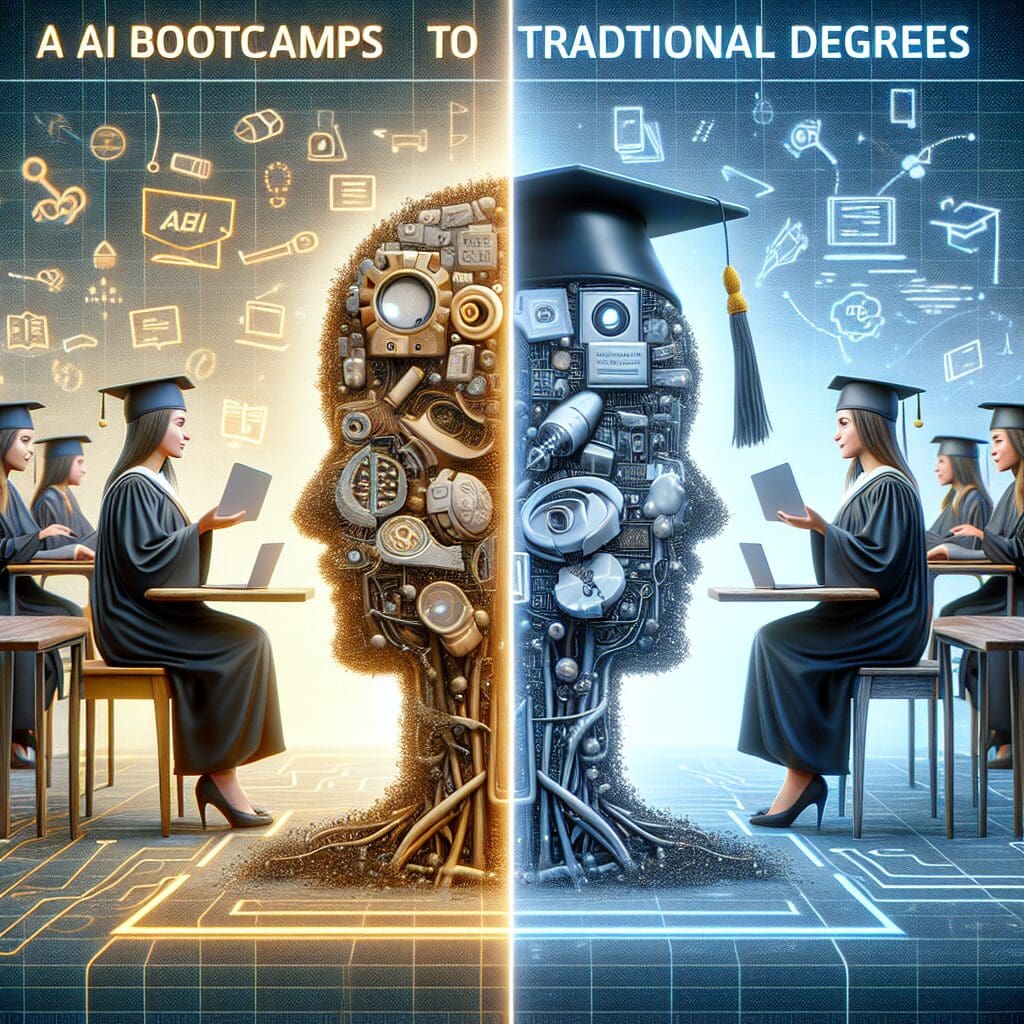
Artificial Intelligence is no longer a buzzword at the fringes of technology but a powerful driver transforming industries, job roles, and required skills at a breathtaking pace. As automation becomes pervasive and new AI-powered roles emerge, education pathways are under the microscope. The key question for anyone eyeing an AI career or adapting to the changing workforce is clear: “AI bootcamps vs. traditional degrees—which path is best to thrive in today’s evolving job market?”
In this deep-dive, we compare AI bootcamps and traditional university degrees—exploring how each prepares professionals for the future of work, the impact of AI on employment, what skills are in high demand, and how to choose a pathway that aligns with your goals as automation accelerates.
The Game-Changer: How AI Is Redefining Work and Skills
AI’s influence on the workforce is monumental. From automating repetitive administrative tasks to powering new digital experiences, the technology is reshaping every sector. This upheaval brings both challenge and opportunity.
Major Shifts in Employment Landscape:
- Role Changes: By 2030, up to 14% of workers globally—about 375 million people—may need to pivot to new careers as AI transforms or replaces their current jobs.
- Urgent Upskilling: 44% of the workforce will require either upskilling or reskilling to stay competitive by 2025, as automation reshapes the core of their roles.
- Selective Impact: Some positions face steep declines. For instance, demand for medical transcriptionists and customer service representatives is predicted to drop 4.7% and 5% respectively by 2033. Simultaneously, entirely new job categories are emerging around developing, implementing, and maintaining AI systems.
Emerging Critical Skill Sets:
As organizations embrace AI, the skills they seek are shifting. The most in-demand include:
- Data analytics and interpretation
- Project management focused on tech and automation
- IT support and systems maintenance
- User experience (UX) design attuned to human-AI interaction
- Cybersecurity tailored for intelligent systems
- Human resources with an emphasis on tech-forward workforces
Equally important are durable soft skills, like critical thinking, adaptability, and creative problem-solving, which enable collaboration with intelligent systems and support ongoing learning in a dynamic environment.
AI Bootcamps vs. Traditional Degrees: Choosing Your Pathway
With a shifting employment landscape and rising demand for new skills, both AI bootcamps and traditional university degrees have risen to the challenge—but they take fundamentally different approaches. For anyone weighing these options, it’s essential to understand how they stack up.
Duration and Pace
AI bootcamps are designed for speed and efficiency. Most run for 3 to 12 months, packing intensive, immersive instruction into a short timeframe. This accelerated pace is ideal for those eager to transition careers, respond to emerging trends, or upskill quickly in response to workplace changes.
Traditional degrees, by contrast, typically require a longer commitment—two to four years for an undergraduate program, with further time for postgraduate studies. This path is thorough and systematic, offering deep theoretical knowledge but at the expense of speed.
Focus and Curriculum Relevance
Bootcamps are practical and market-focused. Their curricula are continuously updated to keep pace with the swift evolution of AI tools and practices. Expect “learning by doing”: real-world coding, hands-on projects, and work with the latest platforms and models (think prompt engineering, deploying language models, and building AI-integrated applications). Bootcamps rapidly integrate new skills and technologies in response to employer demand, giving graduates an immediate edge.
Traditional degrees offer a well-rounded foundation, going deeper into theoretical concepts, mathematics, computer science fundamentals, and the ethical and societal implications of AI. While this breadth supports robust long-term understanding and adaptability, university curriculums often struggle to match the real-time agility seen in bootcamps, sometimes lagging behind the pace of industry breakthroughs.
Cost and Accessibility
AI bootcamps are significantly less expensive, with most programs priced between $5,000 and $20,000. Lower tuition and shorter duration mean the investment is more accessible, and the return on investment—a new job or skillset—comes quicker.
University degrees, particularly at top institutions, command steep tuition: four-year programs typically range from $40,000 to $150,000 or more. Entry requirements are also more stringent, with prerequisites that may deter non-traditional learners or career switchers.
Employer Recognition and Career Mobility
Traditionally, university degrees have carried weight across industries and are sometimes required for advancement into leadership, research, or specialized development roles. They enable access to a broader spectrum of opportunities, including further academic advancement.
However, industry perception of bootcamps is evolving rapidly, especially in tech. Many employers in leading digital industries are shifting their focus to demonstrated skills and hands-on experience. Bootcamps often partner directly with tech firms- offering pipelines to employment and alumni networks facilitating fast-track hiring. While bootcamps may have less recognition in fields that are slower to change, their graduates are increasingly valued where agile, up-to-date AI expertise is needed most.
The Strengths and Trade-offs of Each Pathway
The Rise of Bootcamps: Agility Meets Demand
AI bootcamps have flourished as organizations race to find talent that can keep pace with the explosive demand for new AI capabilities.
What sets bootcamps apart?
- Agility: Bootcamps regularly revamp their courses to feature the latest AI models, cloud tools, and machine learning techniques as soon as they become relevant.
- Practical Skills: Students spend far more time building real projects rather than just studying theory. This hands-on practice ensures graduates hit the ground running.
- Accessibility: Programs are open to a wide range of learners, including those with non-traditional backgrounds, career switchers, and those without a formal technical degree.
- Fast Job Readiness: Bootcamp graduates can become employment-ready in just months, responding to urgent talent shortages and new job opportunities driven by AI adoption.
- Direct Industry Linkages: Many bootcamps have built-in partnerships with tech companies, giving students early access to interviews, internships, or project collaborations.
The Enduring Strengths of Traditional Degrees
Despite the rapid ascendance of bootcamps, traditional degrees maintain strengths that remain essential in AI’s future.
Where do degrees shine?
- Theoretical Depth: University programs ensure a robust understanding of computer science, advanced mathematics, data structures, algorithms, and the societal impacts of technology.
- Broader Recognition: Degrees open doors to formal research, higher education (such as master’s and PhD programs), and leadership roles that still require formal credentials.
- Versatility: The broader educational background supports career pivots outside immediate technology roles, from consulting to academia and policy development.
- Longevity: Fundamental theoretical knowledge provides lasting adaptability as technology evolves over the long term.
Market and Industry Trends: Real-World Evidence of Change
The original question—AI bootcamps vs. traditional degrees—cannot be answered in a vacuum. Real labor market trends provide critical context for career decisions.
- AI Is Transforming IT: An overwhelming 92% of IT roles are currently being reshaped by AI, particularly entry-level and mid-tier positions. Employers report an urgent need for talent who can deploy, manage, and evolve AI systems within existing tech stacks.
- Growing Worker Anxiety: 77% of employees worry about being replaced by AI in the near future. Rather than retreat, those who proactively reskill and upskill have the greatest chance of future-proofing their careers.
- Surge in Reskilling: Over the next three years, around 20 million workers are projected to retrain—many entering AI-related fields, further swelling the need for fast, effective training options.
- Boom in New Tech Roles: Markets are actively seeking AI project managers, data analysts, automation and integration specialists, and prompt engineers—precisely the kinds of jobs bootcamp graduates are trained to fill.
- Ongoing Disruption: As AI capabilities expand, the cycle will only accelerate, with traditional roles evolving and new ones emerging in real time.
To better understand how these changes are playing out, check out our main pillar article on AI job market trends for 2025.
Practical Takeaways: How to Decide Which Path Is Right for You
With so much at stake, how should aspiring AI professionals, career changers, or working professionals approach the decision between an AI bootcamp and a traditional degree?
1. Assess Your Current Situation and Career Goals
- Speed vs. Depth: If your primary objective is to enter the AI workforce quickly, or to pivot to an AI-related job in months rather than years, a bootcamp is likely to suit your needs. If your interests are more research-oriented, academic, or you seek future flexibility across many fields, a degree may be the better long-term play.
- Background: For those without traditional technical backgrounds or those burned out by lengthy academic requirements, bootcamps offer lower barriers and a practical onramp. If you already hold a degree or advanced credentials, a bootcamp can supplement your existing foundation.
- Budget: Factor in the return on investment. When considering total cost and time out of the workforce, bootcamps offer savings and shorter paths to new salaries. Traditional degrees can pay off in the long term with broader career access and credentials that never expire.
2. Prioritize Market-Relevant Skills
- Bootcamps: Look for programs that emphasize not just coding and modeling, but also data ethics, version control, cloud computing, and real-world project collaboration. Ask about job placement support and industry partnerships.
- Degrees: Select curricula that incorporate AI electives, offer industry projects, or include opportunities for internships or research with tech companies. Consider minors or certificates in high-demand areas like data science or cybersecurity.
3. Stay Agile and Keep Learning
- Continuous Learning: Regardless of the pathway you choose, the only constant in AI is rapid change. Seek ongoing professional development, join communities of practice, and look for micro-credentials or online courses to fill skill gaps as they appear.
- Soft Skills Matter: Strengthen your adaptability, problem-solving, and collaboration skills. These will future-proof your career as technical requirements continue to evolve.
- Networking: Engage with alumni, join industry events or hackathons, and get involved in open-source AI projects. These connections can be as decisive as formal credentials when landing your next job.
4. Know Your Industry
- Tech-forward Employers: If your goal is to work for fast-moving tech firms, startups, or in positions directly aligned with AI development, a bootcamp credential—backed by a robust portfolio—can be highly effective.
- Conservative Fields: For more traditional industries or institutions (health care, government, academia), a university degree still carries unique weight and may be required for advancement or specialized positions.
The Bottom Line: Complementary Pathways in an AI Future
The AI-driven future does not demand a one-size-fits-all approach to education and career advancement. Instead, it rewards those who make informed, proactive choices aligned with their ambitions and the skills of tomorrow.
Key Takeaways:
- AI bootcamps deliver timely, practical, and hands-on instruction, making them a powerful springboard for rapid career pivots or immediate upskilling as AI transforms industries. Their energy, inclusivity, and agility meet the pressing needs of a disrupted job market.
- Traditional university degrees remain a gold standard for depth, long-term flexibility, and recognition, particularly in fields requiring robust theoretical grounding, research, or leadership credentials.
- Both pathways are relevant and valuable. Many professionals will combine them over a lifetime—using bootcamps for specific upskilling and degrees for foundational learning or career expansion.
Action Steps:
- Define your goals and priorities.
- Evaluate your current background, available resources, and timeline.
- Choose the education pathway that best addresses pressing skill gaps and positions you for the opportunities you want.
- Stay engaged with the broader AI ecosystem—today’s best opportunities are found by those who remain curious, connected, and ready for lifelong learning.
AI is not just reshaping how we work; it is reshaping how we learn, adapt, and grow. By aligning your education pathway with both current and future trends, you’ll be equipped to thrive in the new intelligence economy.
Ready to explore more insights and strategies for a successful AI career? Dive into the latest articles and expert analyses at AIBest.Site.