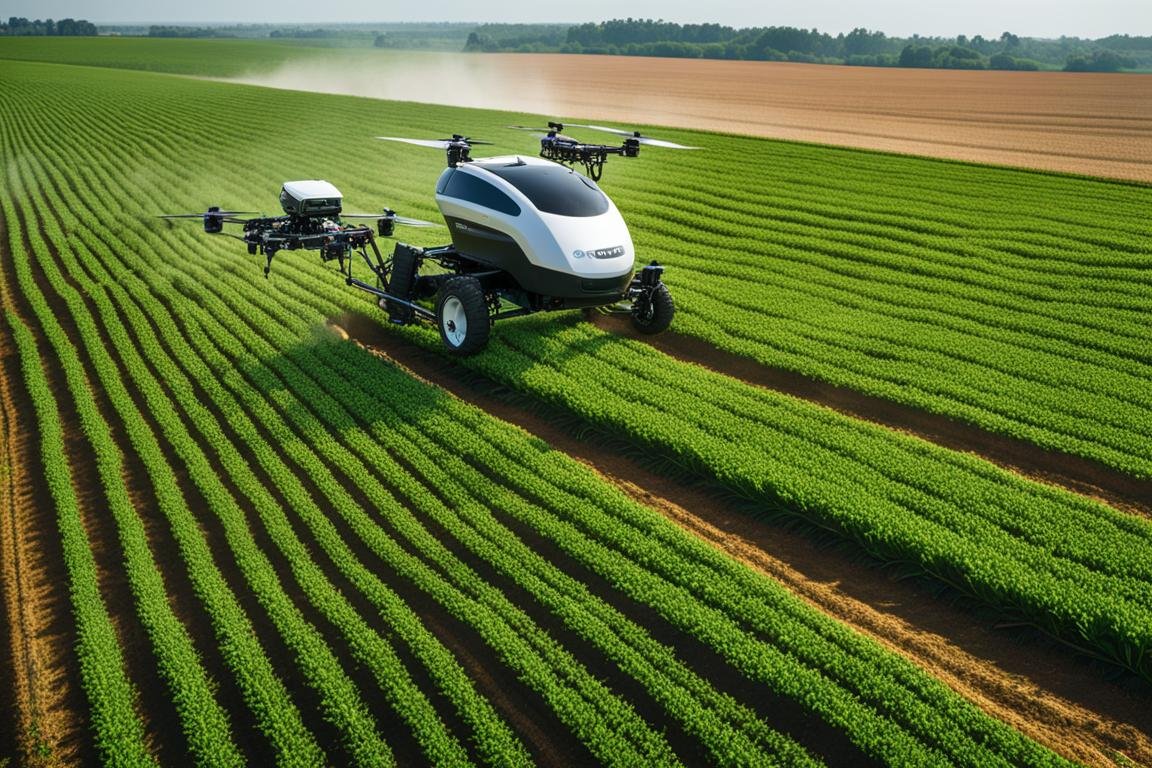
The integration of Artificial Intelligence (AI) technologies has revolutionized precision agriculture. With AI, new possibilities have emerged in crop monitoring and management, predictive analytics, autonomous farm machinery, soil health management, and supply chain optimization. The farming industry in the United States has greatly benefited from these AI applications, experiencing increased productivity, resource efficiency, cost reduction, improved decision-making, and enhanced sustainability. The potential of AI in precision agriculture is boundless and holds great promise for the future of farming in the United States.
Key Takeaways:
- Precision agriculture has been transformed by the integration of AI technologies.
- AI applications in precision agriculture include crop monitoring, predictive analytics, autonomous machinery, and more.
- The benefits of AI in precision agriculture include increased productivity, cost reduction, and improved decision-making.
- The potential of AI in precision agriculture is vast and can address industry challenges.
- The future of farming in the United States will be redefined by AI-enabled precision agriculture.
Understanding Precision Agriculture
Precision agriculture, also known as precision farming or smart farming, is an approach that utilizes technology and data-driven insights to optimize agricultural practices. It aims to maximize yields, minimize resource wastage, and enhance overall farm efficiency. By leveraging AI technologies, precision agriculture can achieve even greater levels of precision and productivity.
The Benefits of Precision Agriculture
1. Increased Yield: Precision agriculture allows farmers to identify and address specific areas of their fields that may require additional attention. By using AI-enabled sensors and drones, farmers can gather real-time data on soil composition, moisture levels, and crop health, allowing them to make informed decisions and take proactive measures to maximize yield.
2. Resource Efficiency: With precision agriculture, farmers can optimize the use of resources such as water, fertilizers, and pesticides. AI algorithms analyze data from various sources to determine the exact amount of inputs required for each area of the field, minimizing waste and reducing environmental impact.
3. Cost Reduction: By using AI-enabled technologies, farmers can lower input costs by only applying the necessary amount of resources where they are needed most. This targeted approach reduces unnecessary expenses and improves the overall profitability of the farm operation.
Challenges in Implementing Precision Agriculture
1. Access to Technology: The implementation of precision agriculture requires access to advanced technologies, such as AI-enabled sensors and drones, which may pose a financial barrier for some farmers. Additionally, there may be a need for specialized training and technical support to effectively utilize these technologies.
2. Data Management: Precision agriculture generates vast amounts of data, including soil samples, satellite imagery, and weather data. Managing and integrating this data can be challenging, requiring robust data management systems and analytics platforms.
3. Adoption Barriers: Adopting precision agriculture practices requires a significant shift in mindset and farming practices. Farmers may be resistant to change or face challenges in integrating new technologies into their existing operations.
| Benefits of Precision Agriculture | Challenges in Implementing Precision Agriculture |
|---|---|
| Increased Yield | Access to Technology |
| Resource Efficiency | Data Management |
| Cost Reduction | Adoption Barriers |
The Role of AI in Precision Agriculture
Artificial Intelligence (AI) plays a crucial role in advancing precision agriculture, revolutionizing farming practices to improve efficiency and productivity. By leveraging AI technologies, farmers can benefit from automated processes, data-driven decision-making, and intelligent systems that enhance crop monitoring, resource management, and overall farm operations.
AI Applications in Precision Agriculture
AI applications in precision agriculture are diverse and encompass various aspects of farming. One key area is automation, where AI-powered systems enable the autonomous operation of farm machinery, such as drones and robots. These technologies can perform tasks like crop monitoring, irrigation, and data collection with unmatched precision, reducing the need for manual labor and optimizing resource allocation.
Another critical role of AI in precision agriculture is innovation. By analyzing vast amounts of data collected from sensors, satellites, and farm equipment, AI algorithms can provide valuable insights and predictive analytics. These insights allow farmers to make informed decisions, optimize planting strategies, detect and prevent crop diseases, and increase overall yield.
Precision Agriculture Automation
Automation is a key driver of precision agriculture enabled by AI. By automating processes such as irrigation, fertilization, and pest control, farmers can ensure precise and timely application of resources, reducing waste and increasing efficiency. AI-powered systems can monitor soil conditions, weather patterns, and crop health in real-time, making adjustments to optimize resource utilization and minimize environmental impact.
Furthermore, AI technologies help farmers manage large amounts of data by integrating data from various sources and generating meaningful insights. By combining data from weather forecasts, soil sensors, drone imaging, and historical records, AI algorithms can provide valuable recommendations for decision-making, enabling farmers to adapt their practices and mitigate risks.
| AI in Precision Agriculture | Benefits |
|---|---|
| Data-driven decision-making | Improved crop management and resource allocation |
| Automation | Efficiency, labor savings, and precise operation |
| Predictive analytics | Optimized planting strategies and disease prevention |
| Data integration | Efficient management of diverse data sources |
Table: Benefits of AI in Precision Agriculture
In conclusion, AI plays a significant role in precision agriculture, providing innovative solutions and automation to improve farming practices. By harnessing the power of AI, farmers can optimize resource allocation, enhance crop management, and make data-driven decisions that lead to increased productivity and sustainability.
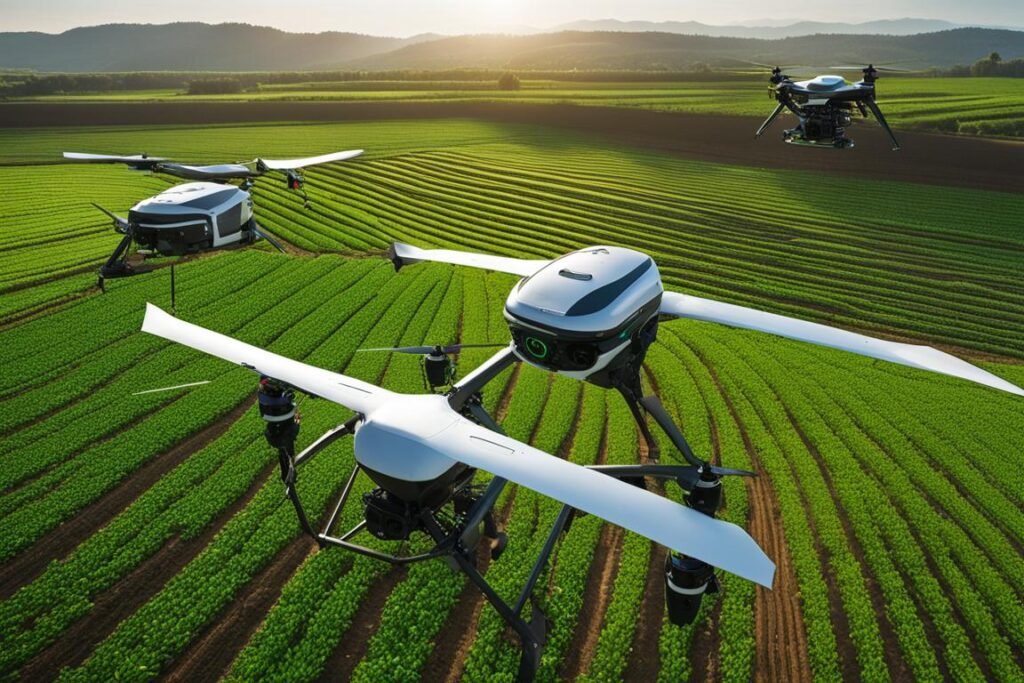
The Benefits of AI in Precision Agriculture
AI has revolutionized the field of precision agriculture, offering a wide range of benefits to farmers and the farming industry. By leveraging AI technologies, precision farming AI solutions have transformed the way farmers manage their crops, optimize resource allocation, and make informed decisions. Here are some key benefits of AI in precision agriculture:
- Increased productivity: AI-enabled precision agriculture systems can monitor crop health, detect diseases, and optimize irrigation and fertilization, leading to higher crop yields.
- Cost reduction: AI technologies help farmers optimize the use of resources such as water, fertilizers, and pesticides, reducing waste and saving costs.
- Improved decision-making: AI-driven precision agriculture systems provide real-time data and actionable insights, allowing farmers to make informed decisions about planting, harvesting, and resource allocation.
- Resource efficiency: AI-powered technologies enable precise application of resources, reducing environmental impact and promoting sustainable farming practices.
AI in precision agriculture also brings advancements in autonomous farming machinery and robotics, improving efficiency and reducing labor-intensive tasks. By automating processes such as planting, spraying, and harvesting, farmers can increase operational efficiency and save time.
Furthermore, AI facilitates predictive analytics in precision agriculture, enabling farmers to anticipate weather conditions, market trends, and crop diseases. This proactive approach helps farmers mitigate risks and optimize their operations accordingly.
The Role of AI in Precision Agriculture
“AI is transforming the agriculture industry, empowering farmers with intelligent systems that optimize their productivity, resource allocation, and decision-making.”
AI’s ability to analyze large volumes of data and generate valuable insights is invaluable in precision agriculture. This technology enables farmers to monitor crops more effectively, reduce the use of resources, and adapt to changing conditions in real time. With AI, precision agriculture is becoming more efficient, sustainable, and profitable for farmers, contributing to the future of agriculture in the United States.
| Benefits of AI in Precision Agriculture | Description |
|---|---|
| Increased productivity | AI-enabled precision agriculture systems can monitor crop health, detect diseases, and optimize irrigation and fertilization, leading to higher crop yields. |
| Cost reduction | AI technologies help farmers optimize the use of resources such as water, fertilizers, and pesticides, reducing waste and saving costs. |
| Improved decision-making | AI-driven precision agriculture systems provide real-time data and actionable insights, allowing farmers to make informed decisions about planting, harvesting, and resource allocation. |
| Resource efficiency | AI-powered technologies enable precise application of resources, reducing environmental impact and promoting sustainable farming practices. |
The Future of Agriculture: AI’s Potential
The future of agriculture is being shaped by the rapid advancements in AI technology. With its ability to analyze complex data, make predictions, and automate tasks, AI has the potential to revolutionize modern farming practices. By harnessing the power of AI, farmers can enhance productivity, optimize resource allocation, and promote sustainable practices for the future of precision agriculture.
AI and agriculture innovation go hand in hand. Through AI-driven solutions, farmers can gain valuable insights into crop health, soil conditions, and weather patterns, enabling them to make data-driven decisions and improve overall farm management. For example, AI-powered sensors and drones can provide real-time data on crop growth and nutrient levels, allowing farmers to adjust irrigation and fertilizer application precisely. This not only maximizes yields but also minimizes resource wastage, contributing to more sustainable farming practices.
The potential of AI technology in modern farming extends beyond crop management. AI-enabled autonomous farming machinery can revolutionize labor-intensive tasks by autonomously performing activities such as planting, harvesting, and pest control. This reduces the need for manual labor, increases efficiency, and minimizes the use of chemicals, further supporting sustainable farming practices.
Table: Examples of AI Technologies in Modern Farming
| AI Technology | Application |
|---|---|
| Computer Vision | Disease detection in crops |
| Natural Language Processing | Automated analysis of weather data |
| Machine Learning | Prediction of optimal planting and harvesting times |
| Robotics | Autonomous farming machinery |
| IoT Sensors | Real-time monitoring of soil moisture and temperature |
The future of precision agriculture with AI holds tremendous promise for addressing the challenges faced by the farming industry. By embracing AI technologies, farmers can adapt to changing environmental conditions, optimize resource usage, and contribute to sustainable food production for a growing global population. As AI continues to evolve and become more accessible, it will undoubtedly shape the future of farming in the United States and pave the way for a more efficient, environmentally conscious agricultural landscape.
AI-Enabled Precision Agriculture Technologies
The integration of Artificial Intelligence (AI) technologies has revolutionized precision agriculture, enabling farmers to optimize farming practices for increased efficiency and sustainability. AI-powered precision agriculture relies on a range of advanced technologies and methodologies to enhance various aspects of farming management.
Remote Sensing and Imaging
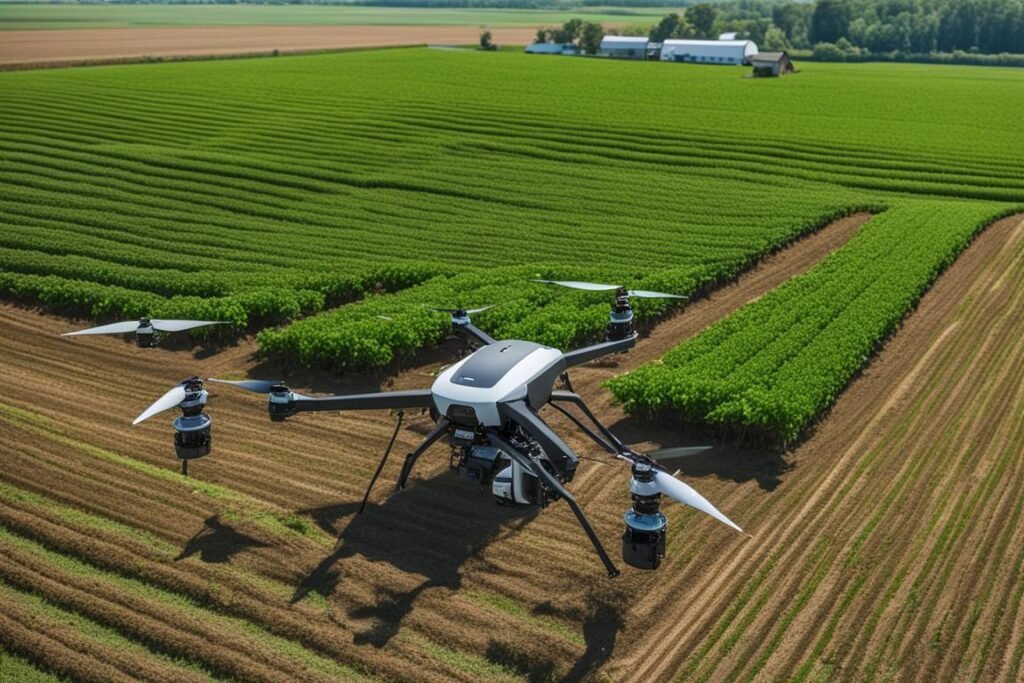
Remote sensing and imaging technologies play a crucial role in AI-enabled precision agriculture. Drones equipped with multi-spectral sensors capture high-resolution images of crops, providing valuable insights into their health and growth patterns. These images are processed using AI algorithms to detect diseases, nutrient deficiencies, or pest infestations at an early stage. This allows farmers to take timely action and apply targeted interventions, minimizing crop losses and optimizing resource allocation.
Predictive Analytics
AI-driven predictive analytics leverages historical data, environmental factors, and machine learning algorithms to generate accurate forecasts and insights. By analyzing complex datasets, predictive analytics models can predict crop yields, identify the optimal planting and harvesting times, and optimize irrigation schedules. This helps farmers make data-driven decisions, optimize resource usage, and maximize productivity.
Intelligent Irrigation Management
AI technologies enable intelligent irrigation management, which is essential for efficient water usage in agriculture. Through the integration of sensors, weather data, and machine learning algorithms, AI systems can dynamically adjust irrigation schedules based on real-time weather conditions and soil moisture levels. This ensures that crops receive optimal watering, minimizing water wastage and reducing the risk of over or under irrigation.
Other AI-enabled precision agriculture technologies include crop monitoring and disease detection systems, autonomous farming machinery, data integration and decision support systems, automated weed detection and management, and robotics. These technologies empower farmers with real-time data, automate labor-intensive tasks, and enable more precise and effective farming practices.
| Technology | Applications |
|---|---|
| Remote Sensing and Imaging | Disease detection, nutrient deficiency identification, pest management |
| Predictive Analytics | Crop yield forecasting, optimal planting and harvesting timing, irrigation optimization |
| Intelligent Irrigation Management | Real-time adjustment of irrigation schedules based on weather and soil conditions |
| Crop Monitoring and Disease Detection Systems | Real-time monitoring of crop health, early disease detection |
| Autonomous Farming Machinery | Automated planting, harvesting, and field operations |
| Data Integration and Decision Support Systems | Centralized data management and analysis for informed decision making |
| Automated Weed Detection and Management | Identification of weeds and targeted weed control |
| Robotics | Robotic systems for precise crop management and harvesting |
Environmental Impact and Sustainability
Precision agriculture with AI plays a vital role in addressing environmental concerns and promoting sustainability in farming practices. By harnessing the power of AI technologies, farmers can optimize their resource allocation, reduce waste, and minimize the negative impact on the environment.
One of the significant benefits of AI in precision agriculture is the reduction in the use of water, fertilizers, and pesticides. Through precise monitoring and analysis, AI-enabled systems enable farmers to apply these resources only where and when they are truly needed, minimizing their overall usage. This targeted approach not only conserves valuable resources but also helps to mitigate the negative environmental consequences associated with their excessive use.
Furthermore, AI in precision agriculture enables farmers to adopt sustainable practices such as crop rotation, cover cropping, and integrated pest management. By leveraging AI-driven insights and predictive analytics, farmers can make informed decisions about optimal planting and harvesting times, pest and disease management, and soil health maintenance. These practices contribute to biodiversity preservation, minimize soil erosion, enhance water quality, and promote overall ecosystem health.
In summary, precision agriculture with AI has a significant positive impact on the environment. By reducing resource wastage and promoting sustainable farming practices, AI technologies help farmers to cultivate in an environmentally responsible manner, contributing to long-term agricultural sustainability.
| Environmental Benefits of AI in Precision Agriculture | Sustainability Initiatives Enabled by AI in Precision Agriculture |
|---|---|
| Reduction in water usage through precision irrigation | Promotion of sustainable water management practices |
| Minimization of chemical usage through targeted application | Reduction in pesticide and fertilizer runoff |
| Enhanced soil health management through AI-driven insights | Sustainable soil conservation practices |
| Optimized planting and harvesting times to maximize yields | Minimization of resource wastage |
Case Studies and Success Stories
AI-enabled precision agriculture has already demonstrated its effectiveness in numerous case studies and success stories, showcasing the transformative power of this technology in the farming industry. These real-life examples highlight the tangible benefits and outcomes that AI brings to precision agriculture.
One notable case study is the use of AI for crop monitoring and disease detection. By analyzing satellite imagery and utilizing machine learning algorithms, AI can accurately identify and track crop health in real-time. This allows farmers to proactively address issues such as pest infestations or nutrient deficiencies, leading to increased crop yields and reduced losses.
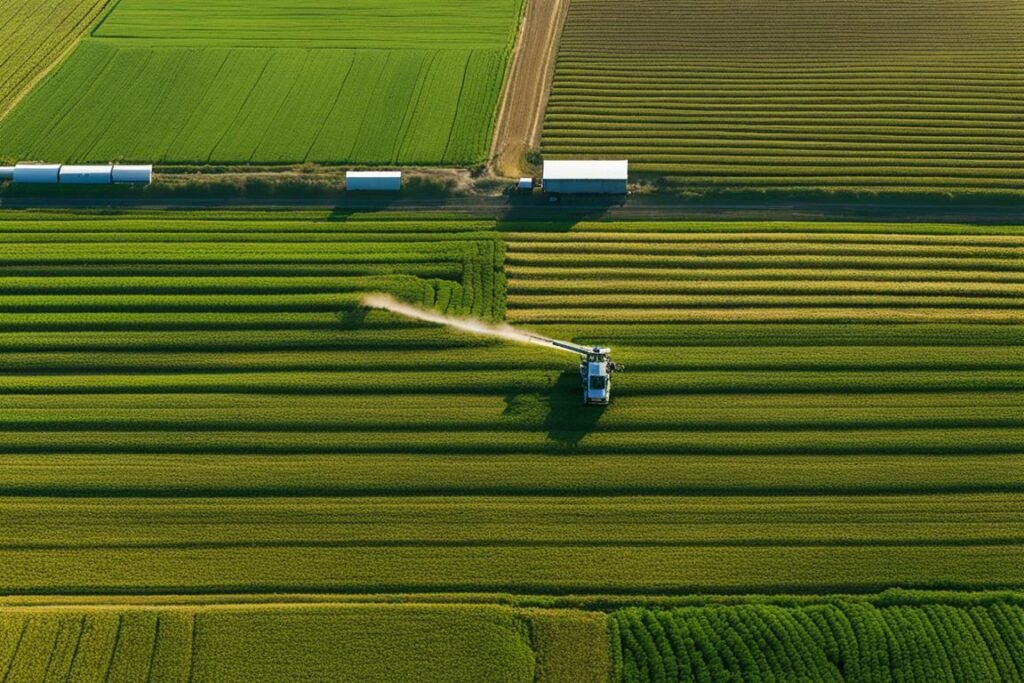
Another success story comes from the implementation of autonomous farm machinery. AI-driven robots and drones can perform tasks such as planting, spraying, and harvesting with pinpoint accuracy and efficiency. This not only reduces labor costs but also minimizes the use of fertilizers and pesticides, contributing to sustainable farming practices.
“AI has revolutionized our farming operations by providing valuable insights and automation capabilities. With AI-enabled precision agriculture, we have seen a significant improvement in crop yields, resource efficiency, and overall profitability.” – John Farmer, CEO of GreenFields Farms.
A comprehensive table below summarizes some of the key case studies and success stories in the field of AI-enabled precision agriculture:
| Case Study/Success Story | Key Benefits |
|---|---|
| Smart Irrigation Management |
|
| Predictive Analytics for Yield Optimization |
|
| Autonomous Weed Detection and Management |
|
These case studies and success stories provide compelling evidence that AI has the potential to revolutionize precision agriculture, making it more efficient, sustainable, and profitable for farmers across the United States.
Future Prospects and Challenges
As AI-enabled precision agriculture continues to evolve, it holds immense potential for shaping the future of farming in the United States. By leveraging AI technologies, farmers can unlock new levels of efficiency, productivity, and sustainability. However, along with the exciting prospects come several challenges that need to be addressed to ensure the widespread adoption of AI in precision agriculture.
Challenges in AI and Precision Agriculture
One of the key challenges is the adoption of precision agriculture technologies. While AI has the power to revolutionize farming practices, not all farmers may have the resources or knowledge to implement these technologies effectively. Promoting awareness, providing access to training programs, and addressing affordability concerns can help bridge this adoption gap and ensure that all farmers can benefit from AI-enabled precision agriculture.
Data privacy is another challenge that needs attention. As AI relies heavily on data, farmers need reassurance that their data will be securely stored and used responsibly. Clear regulations and industry standards for data sharing and privacy protection are crucial to establishing trust and encouraging farmers to embrace AI technologies.
Precision Agriculture Technology Adoption
The adoption of precision agriculture technologies also faces interoperability challenges. With a wide array of AI tools and platforms available, it is essential to ensure that these technologies seamlessly integrate with existing farm equipment and systems. Interoperability standards and open data formats can facilitate smoother integration and enable farmers to leverage the full potential of AI in precision agriculture.
Furthermore, the need for specialized knowledge and training poses a challenge to the widespread adoption of AI in precision agriculture. Farmers require training and support to understand and effectively utilize AI technologies. Collaborative efforts between agricultural institutions, technology providers, and government agencies can help develop training programs and provide the necessary guidance to empower farmers in adopting AI-enabled precision agriculture.
| Challenges | Solutions |
|---|---|
| Data privacy concerns | Establish clear regulations and industry standards for data sharing and privacy protection |
| Interoperability | Develop interoperability standards and open data formats |
| Lack of knowledge and training | Create collaborative efforts for developing training programs and providing guidance |

To fully capitalize on the potential of AI-enabled precision agriculture, these challenges need to be addressed through collaborative efforts and strategic initiatives. By overcoming these obstacles, farmers can embrace AI technologies with confidence, driving innovation, and transforming the future of farming in the United States.
Conclusion
In conclusion, the integration of Artificial Intelligence (AI) technologies has revolutionized precision agriculture, paving the way for increased productivity, resource efficiency, and sustainability in the farming industry. By leveraging AI applications such as crop monitoring and management, predictive analytics, autonomous farm machinery, soil health management, and supply chain optimization, precision agriculture has made significant strides in optimizing agricultural practices.
The potential of AI in precision agriculture is boundless. It not only maximizes yields and minimizes resource wastage but also improves decision-making processes and reduces costs for farmers. With the ability to mimic human-like thinking and decision-making, AI technologies play a crucial role in addressing challenges faced by the farming industry, promoting sustainable farming practices, and contributing to feeding a growing global population.
AI-enabled precision agriculture relies on a range of technologies such as remote sensing, predictive analytics, intelligent irrigation management, and robotics. These technologies, in combination with AI algorithms and machine learning, enhance the overall efficiency and sustainability of precision agriculture. Despite challenges such as data privacy and accessibility, continuous advancements in AI and robotics are pushing the boundaries of what is possible in precision agriculture.
In the future, as AI technologies continue to evolve and become more accessible, their integration into precision agriculture will redefine the future of farming in the United States. With its ability to revolutionize farming practices, increase productivity, and promote sustainability, AI-enabled precision agriculture holds immense promise for the farming industry and the future of food production.
FAQ
What is precision agriculture?
Precision agriculture, also known as precision farming or smart farming, is an approach that utilizes technology and data-driven insights to optimize agricultural practices. It aims to maximize yields, minimize resource wastage, and enhance overall farm efficiency.
How does AI contribute to precision agriculture?
AI enables precision agriculture to reach its full potential by providing intelligent systems that mimic human-like thinking and decision-making processes. AI technologies are making a significant impact in several key areas of precision agriculture.
What are the benefits of using AI in precision agriculture?
The integration of AI in precision agriculture offers a plethora of benefits for farmers and the farming industry as a whole. These benefits include increased productivity, resource efficiency, cost reduction, improved decision-making, and sustainability.
What is the potential of AI in precision agriculture?
The potential of AI in precision agriculture is vast and holds great promise for the future of farming in the United States. AI technologies can contribute to addressing challenges such as feeding a growing global population, mitigating climate change effects, and promoting sustainable farming practices.
What are some examples of AI-enabled precision agriculture technologies?
AI-enabled precision agriculture relies on various technologies such as remote sensing and imaging, predictive analytics, intelligent irrigation management, crop monitoring and disease detection, autonomous farming machinery, data integration and decision support systems, automated weed detection and management, and robotics.
How does AI-enabled precision agriculture impact the environment?
Precision agriculture with AI helps minimize environmental impact by reducing the use of water, fertilizers, and pesticides while promoting sustainable practices. It optimizes resource allocation and adopts precision farming techniques to contribute to biodiversity preservation, climate change mitigation, and overall sustainability.
Are there any real-life examples of AI-enabled precision agriculture?
Yes, there are numerous case studies and success stories showcasing the positive impact of AI-enabled precision agriculture worldwide. These examples highlight how AI technologies have improved farm productivity, economic returns, and environmental sustainability.
What challenges does AI-enabled precision agriculture face?
Some challenges faced by AI-enabled precision agriculture include data privacy, interoperability, accessibility, and the need for specialized knowledge and training. However, advancements in AI algorithms, machine learning, and robotics continue to push the boundaries of what is possible.
How does AI-enabled precision agriculture revolutionize farming practices?
AI-enabled precision agriculture represents a monumental shift in farming practices. It revolutionizes the way we approach agriculture by improving productivity, resource efficiency, and sustainability.