As the agriculture industry continues to evolve, the integration of artificial intelligence (AI) is playing a pivotal role in transforming farming practices. The adoption of AI-powered technologies, such as automated farming systems and precision farming solutions, is revolutionizing the way we cultivate crops and manage resources.
In this article, I will delve into the various applications of AI in agriculture, ranging from AI-driven robotics to advanced automation systems. We will explore how AI is enhancing efficiency, optimizing resource allocation, and maximizing crop yield in farms across the country.
Key Takeaways:
- AI is revolutionizing the agriculture industry through automation and precision.
- AI-powered robots and sensors can increase efficiency and optimize resource allocation in farming.
- Precision farming techniques driven by AI algorithms enable targeted resource use and improved crop health.
- AI technology in agriculture facilitates crop monitoring, disease detection, and pest control.
- Challenges in data availability, standardization, and cost need to be addressed for widespread AI adoption in agriculture.
The Impact of AI on Agriculture
AI technology is making a significant impact on the agricultural industry, revolutionizing the way farming is done. With the introduction of automation and precision, AI is transforming traditional farming practices into smart and efficient operations. Automation in farming tasks is improving productivity and reducing the reliance on manual labor, resulting in optimized resource allocation and increased efficiency.
One of the key applications of AI in agriculture is precision farming. AI-powered robots equipped with advanced algorithms can perform various tasks such as planting seeds, watering crops, and harvesting produce. These robots operate with precision and efficiency, optimizing the use of resources and maximizing crop yield. Additionally, AI algorithms can analyze data from sensors, weather forecasts, and satellite imagery to provide farmers with precise recommendations on planting, irrigating, and harvesting, enabling them to make informed decisions based on real-time data.
AI also plays a crucial role in pest control and disease detection. By utilizing AI technology, farmers can identify and treat threats to crop health in a timely manner. AI-based systems can monitor crops and detect early signs of diseases, nutrient deficiencies, and pest infestations by analyzing images captured by drones or cameras. Early detection allows farmers to take immediate action, preventing the spread of diseases, and minimizing crop losses.
| Application | Benefits |
|---|---|
| Precision Farming | Optimized resource allocation, increased efficiency, and maximized crop yield. |
| Pest Control and Disease Detection | Early detection and timely treatment of threats to crop health, minimizing crop losses. |
| Automation in Farming | Increased productivity, reduced operational costs, and overcoming labor shortages. |
AI in agriculture is transforming the industry from a labor-intensive sector into a knowledge-intensive one. By harnessing the power of AI, farmers can make data-driven decisions, optimize resource management, and implement sustainable farming practices. The impact of AI on agriculture is undeniable, and as technology continues to advance, the possibilities for further innovation and improvement are immense.
Applications of AI in Agriculture
AI technology has made significant advancements in the field of agriculture, offering a wide range of applications that improve efficiency, sustainability, and productivity. From crop monitoring to pest control to resource management, AI is revolutionizing farming practices. By harnessing the power of AI, farmers can make data-driven decisions, optimize resource allocation, and ensure the health and productivity of their crops.
AI in Crop Monitoring
One of the key applications of AI in agriculture is crop monitoring. Through advanced computer vision technology and machine learning algorithms, AI systems can analyze images captured by drones or cameras to assess crop health, detect signs of disease, and identify nutrient deficiencies. This enables farmers to identify potential issues early on and take prompt action, minimizing crop losses and optimizing yield. By continuously monitoring crops with AI, farmers can ensure that their plants receive the necessary care and intervention for optimal growth and productivity.
AI in Pest Control
Pest control is a critical aspect of agriculture, and AI is playing a significant role in this area. AI algorithms can analyze data from various sources, including weather patterns, pest population dynamics, and historical data, to predict and prevent pest infestations. By employing AI-powered pest control systems, farmers can implement targeted and effective pest management strategies, minimizing the use of chemical pesticides and reducing the environmental impact. AI in pest control enhances sustainability in agriculture while protecting crop health and increasing yield.
AI in Resource Management
Efficient resource management is essential for sustainable farming practices, and AI technology provides valuable tools for optimizing resource allocation. AI algorithms can analyze real-time data on soil moisture, weather conditions, and crop growth to optimize irrigation scheduling, conserve water, and reduce waste. Additionally, AI can help farmers make informed decisions regarding fertilization, enabling precise nutrient management and minimizing the environmental impact. By leveraging AI in resource management, farmers can improve resource efficiency, reduce costs, and promote sustainable agricultural practices.
| Application | Benefits |
|---|---|
| Crop Monitoring | – Early detection of crop diseases and nutrient deficiencies – Optimized crop health and yield – Minimized crop losses |
| Pest Control | – Predictive and targeted pest management strategies – Reduced reliance on chemical pesticides – Enhanced crop protection and sustainability |
| Resource Management | – Efficient irrigation scheduling and water conservation – Precise nutrient management – Reduced environmental impact |
These are just a few examples of how AI is transforming agriculture and revolutionizing farming practices. By harnessing the power of AI technology, farmers can optimize their operations, increase productivity, and contribute to a more sustainable and efficient agricultural industry.
Precision Farming with AI
Precision farming, also known as precision agriculture, is a farming technique that utilizes data-driven insights and AI algorithms to optimize various aspects of farm operations. By harnessing the power of AI, farmers can make informed decisions based on real-time data, resulting in improved crop health, increased productivity, and optimized resource allocation.
One of the key components of precision farming is the use of AI algorithms to analyze data collected from sensors, satellites, and drones. These algorithms can provide farmers with precise recommendations on planting, fertilizing, and harvesting, taking into account factors such as soil moisture, temperature, and nutrient levels. This data-driven approach allows farmers to target specific areas of their fields, conserving resources and increasing efficiency.
Additionally, AI-powered systems can monitor crop health and detect early signs of diseases, nutrient deficiencies, and pest infestations. By analyzing images captured by drones or cameras, AI algorithms can quickly identify anomalies in plant health and alert farmers to potential issues. This early detection enables farmers to take immediate action, preventing the spread of diseases and minimizing crop losses.
Benefits of Precision Farming with AI
The adoption of precision farming techniques with AI offers several benefits to farmers:
- Increased crop yield: By optimizing resource allocation and monitoring crop health, precision farming with AI can help farmers achieve higher crop yields.
- Reduced resource waste: AI algorithms can analyze data on soil moisture, temperature, and other environmental parameters to optimize irrigation schedules, conserving water and reducing resource waste.
- Improved efficiency: Through data-driven insights and automation, precision farming with AI enables farmers to streamline their operations and increase overall efficiency.
- Enhanced sustainability: By minimizing the use of resources and preventing crop losses through early detection of diseases and pests, precision farming with AI promotes sustainable farming practices.
Overall, precision farming with AI is revolutionizing the agricultural industry by providing farmers with the tools and insights they need to make data-driven decisions and optimize their farm operations. By harnessing the power of AI algorithms and real-time data, farmers can achieve higher crop yields, reduce resource waste, increase efficiency, and promote sustainable farming practices.
| Benefits of Precision Farming with AI | Examples |
|---|---|
| Increased crop yield | Higher corn yields: 10% increase in crop yield compared to traditional farming methods. |
| Reduced resource waste | Water conservation: 20% reduction in water usage through optimized irrigation scheduling. |
| Improved efficiency | Labor optimization: 30% reduction in labor hours through automation of tasks such as planting and harvesting. |
| Enhanced sustainability | Pest control: 40% reduction in pesticide use through early detection and targeted treatment of pests. |
By leveraging the power of AI in precision farming, farmers can achieve higher crop yields, reduce resource waste, increase efficiency, and promote sustainable farming practices. The combination of data-driven insights and automation enables farmers to optimize their farm operations and make informed decisions, ultimately transforming the way agriculture is practiced.

Crop Monitoring and Disease Detection with AI
One of the key applications of AI in agriculture is crop monitoring and disease detection. With the help of AI algorithms and advanced image analysis techniques, farmers can detect early signs of diseases, nutrient deficiencies, and pest infestations in their crops. By analyzing images captured by drones or cameras, AI algorithms can quickly identify anomalies in plant health and alert farmers to potential issues.
This early detection allows farmers to take immediate action, preventing the spread of diseases and minimizing crop losses. AI-driven technologies in crop monitoring and disease detection enhance productivity and promote sustainable farming practices. By continuously monitoring crop health and detecting problems early on, farmers can implement targeted interventions and treatments, reducing the need for excessive pesticide use and ensuring optimal plant growth.
“By continuously monitoring crop health and detecting problems early on, farmers can implement targeted interventions and treatments, reducing the need for excessive pesticide use and ensuring optimal plant growth.”
Furthermore, AI algorithms can analyze vast amounts of data, including weather patterns, soil conditions, and historical crop data, to predict the likelihood of disease outbreaks and pest infestations. This allows farmers to proactively manage their crops, making informed decisions about irrigation, fertilization, and crop rotation, among other practices.
The integration of AI in pest control is another crucial aspect of crop monitoring. AI algorithms can analyze data from sensors and cameras to identify pests and monitor their movement patterns, aiding in the development of effective pest control strategies. By using targeted interventions based on real-time, data-driven insights, farmers can minimize the use of harmful pesticides and reduce the negative impact on the environment.
Table: Crop Monitoring and Disease Detection Technologies
| Technology | Application | Benefits |
|---|---|---|
| Drones equipped with cameras | Capturing images for crop health assessment | Early detection of diseases and nutrient deficiencies |
| Sensor networks | Monitoring soil moisture, temperature, and other environmental parameters | Optimization of irrigation schedules and resource management |
| Computer vision technology | Analyzing plant images to detect anomalies | Early warning system for diseases and pests |
| AI algorithms | Processing and analyzing large datasets for predictive modeling | Identification of disease outbreaks and pest infestations |
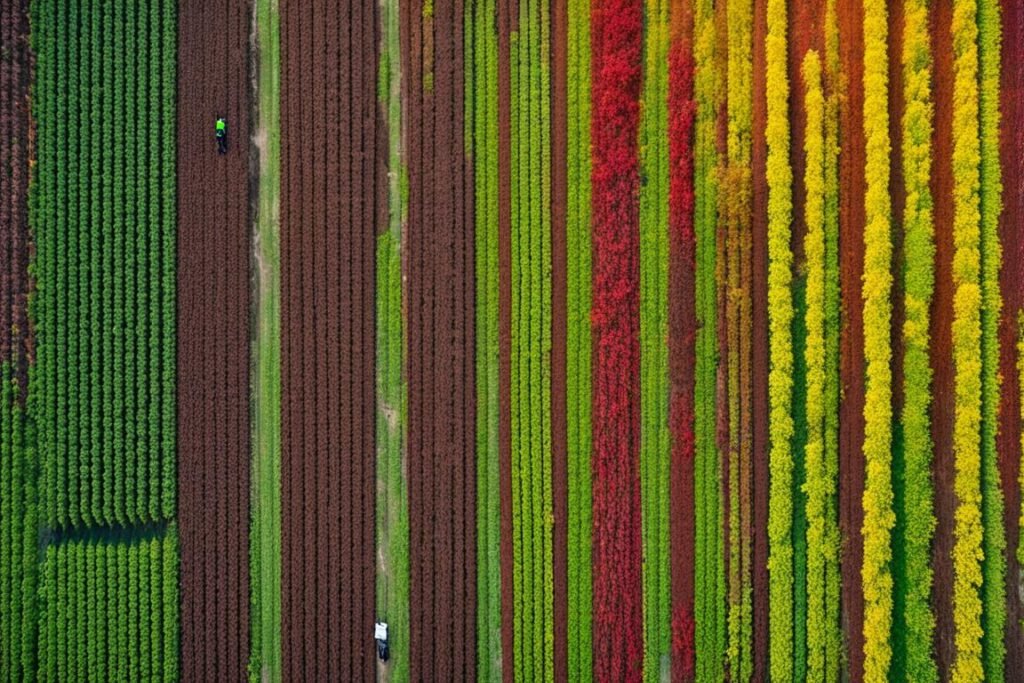
The integration of AI in crop monitoring and disease detection revolutionizes farming practices, allowing farmers to proactively manage their crops and ensure optimal plant health. Through the use of AI algorithms, drones, sensors, and computer vision technology, farmers can detect diseases and pests at early stages, implement targeted interventions, and minimize crop losses. This not only improves productivity and profitability but also promotes sustainable farming practices by reducing the use of pesticides and optimizing resource allocation.
Automation in Farming with AI
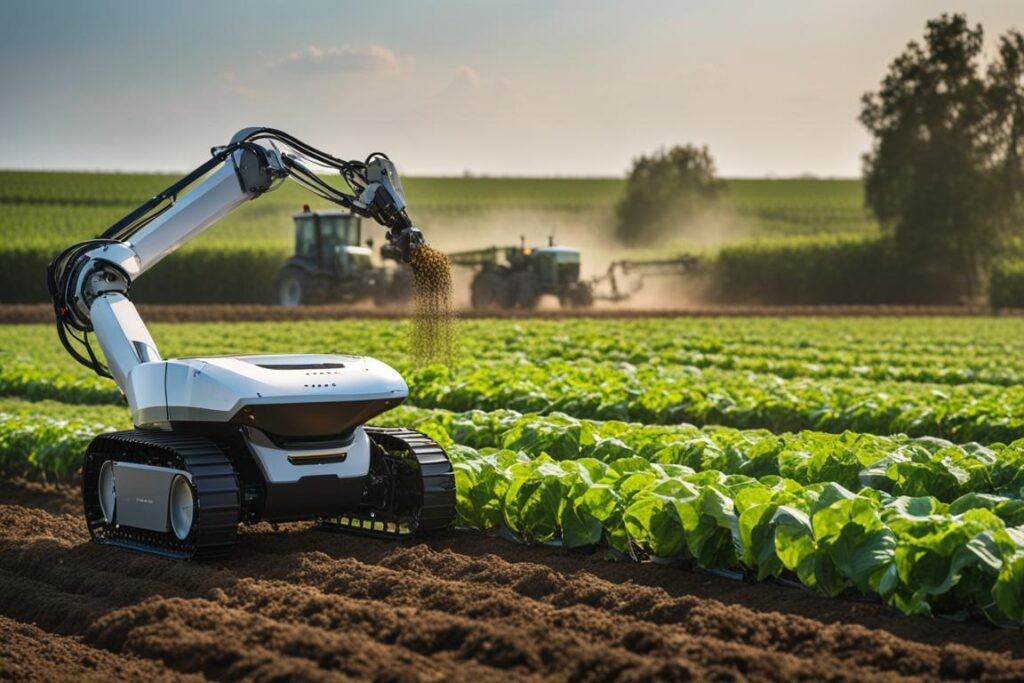
AI-powered robots are revolutionizing the agricultural industry by automating labor-intensive tasks. These advanced machines not only increase productivity but also enhance precision and efficiency in farming operations. With AI technology in agriculture, farmers can optimize their resource allocation, reduce operational costs, and overcome labor shortages.
One of the key advantages of using AI-powered robots in farming is their ability to perform tasks with precision. These robots can plant seeds, water crops, and harvest produce with accuracy, ensuring consistent and high-quality results. By automating these labor-intensive tasks, farmers can save time and focus on other important aspects of their operations.
Furthermore, AI technology in agriculture enables round-the-clock farm operations. These robots can work tirelessly, unaffected by factors such as fatigue, weather conditions, or time constraints. This allows farmers to maximize their output and maintain a consistent level of productivity throughout the day and night.
“The deployment of AI-powered robots in agriculture has significantly transformed the way we cultivate crops. These machines have helped us streamline our operations, increase efficiency, and reduce our reliance on manual labor.”
Overall, automation in farming with AI has brought about a paradigm shift in the agriculture industry. By leveraging AI-powered robots, farmers can improve their efficiency, optimize their resource management, and achieve higher yields. As technology continues to advance, we can expect further breakthroughs in AI-driven solutions that will revolutionize farming practices and pave the way for a more sustainable and productive future in agriculture.
Automation Benefits in Farming
Implementing automation in farming with AI brings several key benefits to farmers and the agricultural industry as a whole:
- Increased productivity: AI-powered robots can perform tasks with precision and efficiency, resulting in higher productivity and improved crop yields.
- Cost reduction: By automating labor-intensive tasks, farmers can reduce operational costs, such as manual labor expenses and reliance on seasonal workers.
- Optimized resource management: AI technology allows for precise resource allocation, ensuring that resources such as water, fertilizers, and pesticides are used efficiently.
- Improved quality control: AI-powered robots can perform tasks consistently and accurately, leading to higher quality produce and reduced waste.
- Round-the-clock operations: AI-powered robots can work continuously, enabling farmers to maximize productivity and maintain consistent output regardless of external factors.
With these benefits, automation in farming with AI is transforming the agricultural industry, making farming practices more efficient, sustainable, and productive.
| Task | Manual Labor | AI-Powered Robot |
|---|---|---|
| Planting Seeds | Labor-intensive and time-consuming | Precision planting with consistent spacing and depth |
| Watering Crops | Manual irrigation prone to inconsistency | Precision watering based on moisture levels |
| Harvesting Produce | Labor-intensive and time-consuming | Precise and efficient harvesting |
Resource Management with AI in Agriculture
Resource management plays a crucial role in sustainable agriculture, and AI technology is revolutionizing how farmers optimize and maximize resource utilization. Through AI algorithms and data-driven insights, farmers can make informed decisions regarding resource allocation, particularly in areas such as irrigation scheduling and resource optimization.
One significant application of AI in resource management is in irrigation scheduling. By analyzing real-time data from IoT sensors, AI algorithms can determine precise irrigation schedules based on factors such as soil moisture, crop water requirements, and weather conditions. This optimization reduces water waste and ensures that crops receive the necessary amount of water for healthy growth. Not only does this improve water efficiency, but it also saves farmers time and effort by automating the process.
AI technology also allows farmers to optimize resource allocation by analyzing and predicting crop health and nutrient requirements. By leveraging AI algorithms in agriculture, farmers can identify areas of nutrient deficiency and adjust fertilizer application accordingly, reducing waste and ensuring optimal crop growth. Furthermore, AI-based monitoring systems can detect and alert farmers to potential pest infestations or diseases, enabling timely intervention and preventing crop losses.
| Resource Management Benefits of AI in Agriculture | Examples |
|---|---|
| Optimized irrigation scheduling | AI algorithms analyze soil moisture, weather forecasts, and crop water requirements to determine precise irrigation schedules, reducing water waste and improving crop health. |
| Improved nutrient allocation | AI algorithms analyze crop data and soil conditions to identify areas of nutrient deficiency, allowing farmers to optimize fertilizer application and reduce waste. |
| Early pest and disease detection | AI-based monitoring systems analyze images and data to identify early signs of pest infestations or diseases, enabling farmers to take timely action and prevent crop losses. |
By harnessing the power of AI algorithms in agriculture, farmers can achieve more efficient and sustainable resource management practices. This not only benefits individual farms but also contributes to the overall sustainability of the agriculture industry.
Image source: https://seo writing.ai/32_6.png
Challenges and Future Possibilities of AI in Agriculture
As the agriculture industry embraces the transformative power of AI, it is not without its fair share of challenges. One of the main hurdles is the availability and quality of data. The success of AI-driven solutions in agriculture depends on accurate and reliable data inputs. Without access to high-quality data, AI algorithms may produce inaccurate recommendations or insights, hindering the effectiveness of AI adoption in farming.
Another challenge is the lack of standardization across AI technologies in agriculture. As the field continues to evolve rapidly, there is a need for industry-wide standards to ensure interoperability and compatibility among different AI systems. Standardization would enable seamless integration and data sharing between various AI applications, allowing farmers to harness the full potential of AI in their operations.
The cost of implementing AI technology in agriculture can also be a barrier for many farmers. While the long-term benefits of AI adoption are promising, the initial investment required can be significant. From purchasing AI-powered equipment to implementing data analytics systems, the financial burden may prevent smaller farmers from embracing AI solutions. Addressing the cost issue and making AI technology more accessible and affordable for all farmers is essential for widespread adoption.
Additionally, the environmental impact of AI in agriculture must be considered. While AI-driven solutions can optimize resource allocation and reduce waste, there are concerns about the energy consumption and carbon footprint associated with AI technologies. It is crucial to develop AI systems that are energy-efficient and environmentally sustainable to ensure that the benefits of AI in agriculture do not come at the expense of the planet.
Future Possibilities
Despite these challenges, the future possibilities of AI in agriculture are vast. As technology continues to advance, AI has the potential to revolutionize farming practices even further. AI algorithms can become more sophisticated and accurate, leveraging larger datasets and advanced modeling techniques. This will enable farmers to make even more informed decisions, optimize resource management, and maximize crop yield.
Furthermore, AI can play a pivotal role in addressing some of the pressing issues in agriculture, such as climate change and food security. AI-powered systems can help farmers mitigate the impact of climate change by providing real-time weather forecasting and risk management solutions. AI can also contribute to ensuring food security by optimizing crop production, reducing waste, and improving overall productivity.
With continued research and development, AI in agriculture holds the promise of creating a more sustainable, efficient, and productive farming industry. By overcoming the challenges and harnessing the full potential of AI, farmers can embrace a future where technology and agriculture go hand-in-hand, leading to a brighter and more prosperous future for all.
Conclusion
In conclusion, the impact of AI in agriculture is undeniable. With its ability to introduce automation, precision, and data-driven insights, AI is revolutionizing farms and transforming the agricultural industry. By leveraging AI-powered robots, smart sensors, and AI algorithms, farmers can optimize resource allocation, increase efficiency, and maximize crop yield.
Despite the challenges that come with data availability, standardization, and implementation costs, the future possibilities of AI in agriculture are promising. As technology continues to advance, AI will play a vital role in shaping the future of farming. It will lead to more efficient, sustainable, and productive agricultural practices.
In summary, AI-driven solutions in agriculture are improving decision-making, crop health and monitoring, labor-intensive tasks, and resource management. The integration of AI technology holds immense potential for the agriculture industry, paving the way for a more efficient and sustainable future.
FAQ
How is AI revolutionizing the agriculture industry?
AI is introducing automation and precision into farming practices, increasing efficiency, optimizing resource allocation, and maximizing crop yield.
What are some applications of AI in agriculture?
AI can be used to analyze data for informed decision-making, optimize crop health and scheduling with precision farming, monitor crops and detect diseases with drones and computer vision technology, automate labor-intensive tasks with AI-powered robots, and leverage AI for weather forecasting and risk management.
How does precision farming with AI work?
Precision farming utilizes data-driven insights to optimize farm operations. AI algorithms analyze data from sensors, satellites, and drones to provide precise recommendations on planting, fertilizing, and harvesting, resulting in increased efficiency and optimized crop yield.
How does AI help in crop monitoring and disease detection?
AI-based systems can monitor crops and detect early signs of diseases, nutrient deficiencies, and pest infestations. By analyzing images captured by drones or cameras, AI algorithms can quickly identify anomalies in plant health and alert farmers to potential issues, helping minimize crop losses.
What is the role of AI-powered robots in agriculture?
AI-powered robots can automate labor-intensive tasks such as planting seeds, watering crops, and harvesting produce with precision and efficiency. This automation increases productivity, reduces operational costs, and overcomes labor shortages on farms.
How does AI contribute to resource management in agriculture?
AI and IoT sensors enable farmers to monitor and manage resources efficiently. By analyzing real-time data on soil moisture, temperature, and other environmental parameters, AI algorithms can optimize irrigation schedules and conserve water. This technology also helps farmers make informed decisions regarding sustainable land management practices.
What are the challenges and future possibilities of AI in agriculture?
Challenges include data availability and quality, lack of standardization, cost of implementation, and environmental impact. However, the future possibilities of AI in agriculture are promising, with continued development leading to increased efficiency, productivity, and sustainability in farming.
How is AI transforming the agriculture industry?
AI is revolutionizing the industry by introducing automation, precision, and data-driven insights. By utilizing AI technology, farmers can optimize resource allocation, increase efficiency, and maximize crop yield, leading to more efficient, sustainable, and productive agriculture practices.